
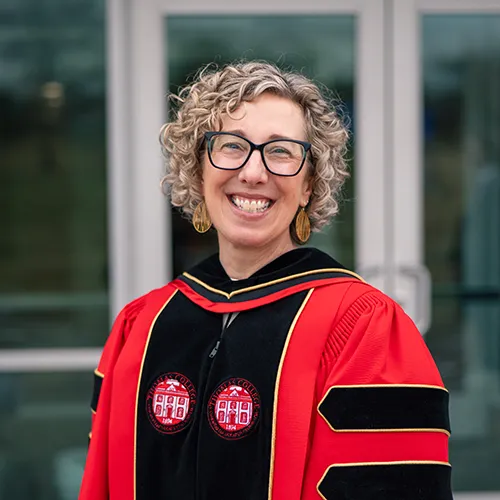
Message from the President
At Thomas College, we don’t just prepare students for the next step in their lives or for a single career. We promise to help students discover who they are, design the life they want, and define how they will contribute to the world and transform it for the better. Thomas 2030 builds on that promise.
When I arrived at Thomas College in November 2024, I was embraced by a community that is deeply personal, deeply practical, and deeply committed to our students’ successes. Today, as higher education is being questioned and reshaped, Thomas College stands out not by accident but by design. We are small enough to know every student’s name, bold enough to embrace necessary change, and grounded enough to remember why we exist.
This plan, shaped by conversations with students, faculty, and staff, outlines where we’re going and how we’ll get there. It calls us to create the college of the future, to become sustainable in new and necessary ways, and to care for our community with even greater intention and impact.
Throughout this plan you will encounter core themes that came up again and again in our strategic planning sessions: a continuing desire to nurture the caring and welcoming community that is Thomas, a desire to enhance belonging for our increasingly diverse student body, the need to offer academic programs that empower students with the personal and professional skills they need to meet their futures, and a commitment to our identity as a college of opportunity and access. The strategies and tactics contained within this plan reflect more than ideas; they represent our shared aspirations and a willingness to act, stretch, and grow to achieve them.
I’m gratified by the engagement and dedication that informed this plan, and I’m even more excited about the work it will guide over the next five years. We are a college with momentum, a noble mission, and a mighty heart. I have every confidence that the next chapter of Thomas College, guided by this plan, will be our most innovative yet.
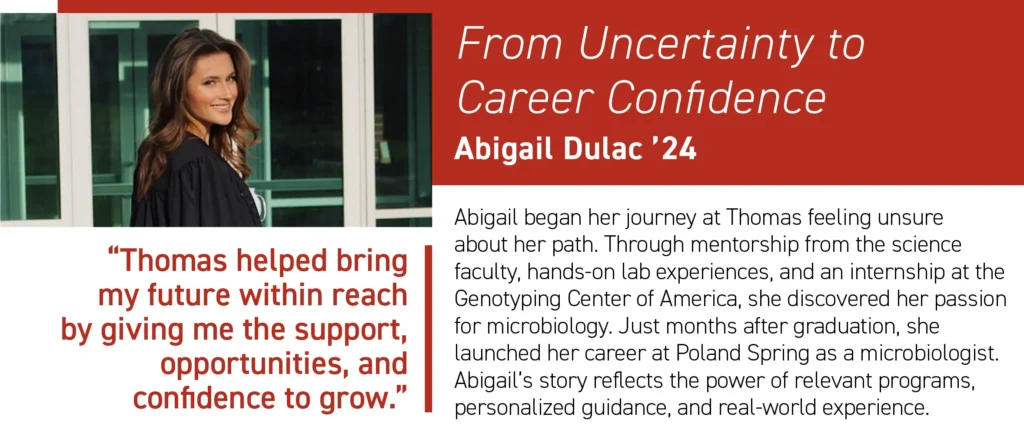
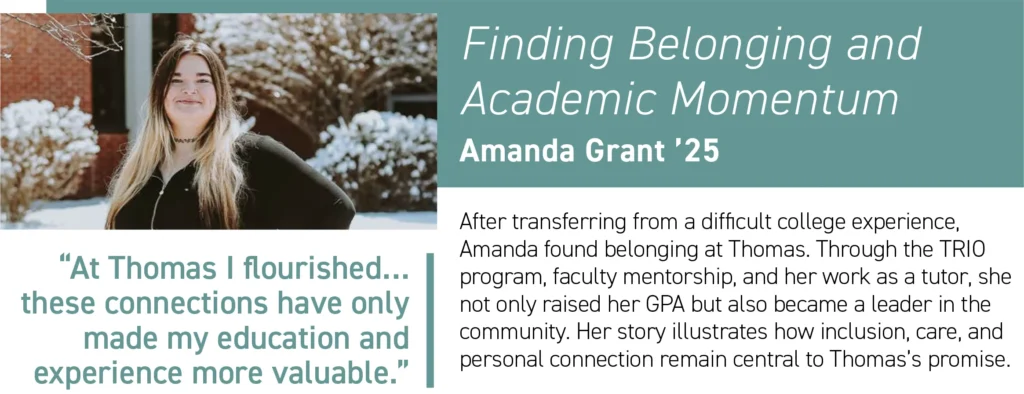
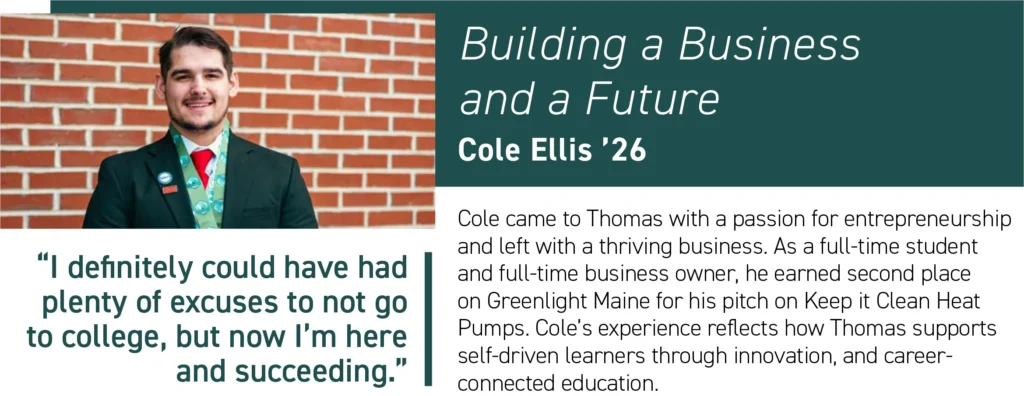
The 2025 - 2030 Strategic Plan
Thomas College’s 2025–2030 strategic plan—Thomas 2030: Building the College of the Future—defines a bold path forward, a path rooted in who we are and designed for who we will become. This plan reflects an inclusive and comprehensive process that solicited input from students, faculty, staff, Board members, and other key partners. Together, we identified what matters most to the Thomas College community; we acknowledged the challenges facing the College and higher education writ large; and we committed to a courageous vision for the future.
At its core, the plan rests on three strategic priorities:
- Build the College of the Future – Evolve our academic programs and student support model to meet the demands of our rapidly changing reality while preserving our personal, supportive, student-centered ethos.
- Become Sustainable – Ensure long-term institutional strength through diversified revenue development, strategic enrollment growth, and operational excellence.
- Care for Our Community – Foster a culture of belonging, wellness, respect, and personal and professional growth for our students, faculty, staff and the external partners with whom we work.
These priorities are supported by five Strategic Enablers: Student-Centered Imperatives, Academic and Programmatic Innovation, Operational Excellence, Brand and Market Positioning, and Enrollment and Finances. Across these Enablers we find recurring themes like belonging, mental health, and artificial intelligence.
Implementation of the plan will reflect Thomas College’s commitment to shared governance, with faculty and staff playing an active role in determining how we realize our strategic priorities. From expanded student support services and enhanced facilities to targeted enrollment pipelines and new academic offerings, this plan reflects the full ambition and heart of Thomas College.
Our challenges are clear: We face declining demographics, increased competition, and shifting expectations about the value of college. Yet in this environment, we see an opportunity to distinguish the College. We will not only adapt, but we will lead, all the while continuing to serve as a college that opens doors and brings promising futures within reach.
Thomas College prepares students for success in their personal and professional lives, and for leadership and service in their communities.
All students will graduate and will have the knowledge, experience, professional and technological skills, and a strong sense of personal strengths and purpose to launch a career and meaningfully contribute to their workplaces and communities.
Our core values define what we do and how we do it. They guide our decisions, are our sounding board in turbulent times, shape our community, and reflect the culture we nurture every day—for students, faculty, staff, and our community partners alike.
- Student-Centered Purpose: We put students at the heart of every decision we make, recognizing their growth as our greatest success.
- Integrity and Accountability: We take responsibility for our actions and hold ourselves to the highest standards— academically, ethically, and operationally.
- Equity and Inclusion: We honor the dignity of every person and commit to creating a campus where all can thrive and feel a sense of belonging.
- Innovation and Adaptability: We embrace change, champion creative thinking, and continuously improve to meet the needs of our shared future.
- Collaboration and Respect: We work across disciplines with humility and shared purpose, valuing every voice and
championing each other’s successes. - Community Engagement and Service: We strengthen our central Maine community, state, and the world by preparing students to lead lives of contribution and civic responsibility.
Thomas College brings promising futures within reach. Every student—regardless of their background— deserves the tools, guidance, and environment to succeed. We promise that each graduate will:
- Graduate with confidence, knowledge, and real-world skills: ready to contribute meaningfully to their careers, communities, and personal lives.
- Know their strengths and purpose: with a deep understanding of their passions and potential for impact.
- Be equipped with 21st-century competencies: including communication, collaboration, critical thinking, and creativity.
- Understand innovation and entrepreneurship: gaining exposure to new ideas, practical problem-solving, and applied creativity.
- Possess technology and digital fluency: ready to navigate and lead in a digitally connected, fast-moving world.
- Embrace diverse perspectives and lived experiences: with a global mindset rooted in empathy, curiosity, and inclusion.
- Access flexible, career-advancing learning pathways: graduate and non-traditional learners will have access to programs designed to fit diverse goals, schedules, and life stages.
- Believe their investment is worth it: leaving Thomas with the skills, confidence, and outcomes to show that their time, effort, and resources were well spent.
This plan is more than a set of strategies; it is a commitment to our community—past, present, and future.
Every goal in this plan—whether it’s about improving systems, growing enrollment, strengthening belonging,
or redesigning curriculum—connects back to real lives and real learners: it all starts with our students.
Thomas College’s 2025–2030 strategic plan is the result of a collaborative, inclusive, and comprehensive process designed to reflect the needs, hopes, and wisdom of our entire community. Shortly after the arrival of President Jeannine Diddle Uzzi Ph.D., the College embarked on a thoughtful, campus-wide effort to clarify our priorities and chart a bold path for the future.
The planning process kicked off at the President’s first Town Hall on November 15, where faculty and staff became familiar with the planning process and with the College’s former plan. January 2025 began with a focus on listening. Through open employee sessions, Faculty Senate sessions, town halls, student conversations, and Student Senate meetings, the College gathered meaningful insights on what makes Thomas College so special, what challenges limit our potential, and what our community hopes Thomas College will become. These sessions quickly brought to the surface recurring themes related to our culture, our academic aspirations, belonging, innovation, visibility, and sustainability that became the foundation of this plan.
Those insights in hand, via a series of facilitated sessions in April and May, a team of 12 comprising 50% faculty and 50% staff considered and shaped community input into goals, strategies, and tactics. This plan reflects a true community effort and integrates insights and data from:
- Six priority-setting forums with students, faculty, and staff
- Purple Sky Consulting enrollment audit
- Two town hall sessions
- Fall 2024 Student Satisfaction Survey
- Fall 2024 Employee Satisfaction Survey
- Ongoing leadership and Board engagement
- Information gathered from community stakeholders
- Weekly cross-functional drafting sessions

Thomas will build long-term institutional strength through strategic enrollment growth, the diversification of
revenue sources, and the creative use of existing resources.
Sustainability will be both fiscal and operational, ensuring we can continue to deliver value to students while
investing in our people, systems, and campus.
Key strategies include:
- Linking expenditures to strategic outcomes
- Creating and adhering to a strategic enrollment plan
- Maximizing non-tuition revenue (events, conferences, professional development, etc.)
- Pursuing new pipelines of corporate philanthropy
- Revising our financial aid strategy to decrease the overall discount rate
- Nurturing existing donor relationships and developing new ones
- Using data to drive all decision-making
- Aligning the use of space, time, and staffing with student needs
We will expand upon our solid but generalized reputation as a caring community so that employees and
external partners affirm that they work in a respectful, responsive, and mutually beneficial way with the College.
We will foster a campus culture where students, faculty, and staff feel supported, valued, and connected.
Key strategies include:
- Increasing faculty and staff compensation in accordance with the market
- Engaging faculty and staff in determining what changes the College should pursue to advance this goal
- Enhancing our employee onboarding process and training
- Investing in strategic professional development for all employees
- Becoming known as the most responsive strategic partner in our region
- Identifying and nurturing relationships with a limited number of primary external partners
Building upon its strong foundation and reputation, Thomas College will distinguish itself as an institution
that uniquely prepares students of all backgrounds to meet the challenges of the coming decades. We will
accomplish this through a forward-looking curriculum and pedagogy that combines high expectations with
unparalleled student support.
Thomas College students will develop the confidence, knowledge, and durable skills to determine their purpose, design the lives they want, and maximize their individual potential.
Key strategies include:
- Establishing holistic student support and engagement informed by our expertise in human development, student development theory, and the social, emotional, mental health, and learning needs of Generation Z
- Creating an intentional academic advising model based in research-informed practices
- Enhancing our curricula to prepare students to thrive in an AI world
- Evolving our general education program to reflect the durable 21st-century skills that will distinguish our students in life and work after college
- Becoming experts in new and inclusive pedagogies like co-ops, universal design for learning, and trauma-informed teaching
- Supporting faculty with the professional development necessary to achieve our strategic goals
- Investing in technology and infrastructure to support curricular and pedagogical innovation and a new
academic advising model, including a new SIS (student information system) and EdSights - Enhancing our infrastructure to support more applied learning, including research, internships, and
community and employer partnerships - Developing additional on-campus employment opportunities and paid learning experiences for students
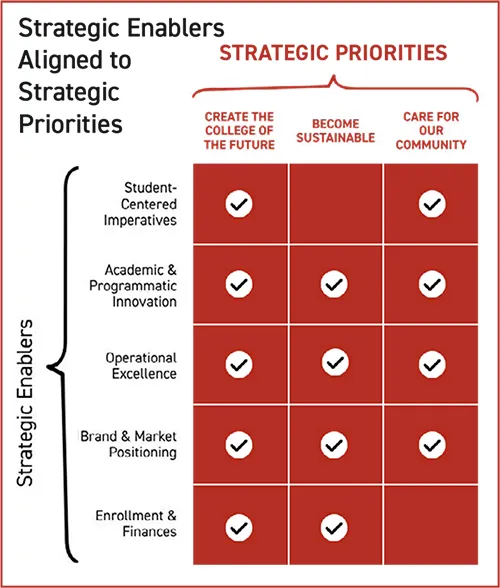
Achieving our three strategic priorities—Become Sustainable, Care for Our Community, Build the College of the Future—requires more than vision. It requires commitment and action across key institutional functions.
We call these functions “Strategic Enablers.”
Strategic Enablers are not silos or islands. They are interconnected domains that support and reinforce the
three priorities and key strategies of this plan.
The following pages describe each Strategic Enabler and
show how each Enabler maps onto the priorities of this plan.
The Strategic Enablers are the drivers—both cultural and operational—that will carry Thomas College forward.
Student-Centered Imperatives
Focus on the student experience from recruitment through graduation and beyond, emphasizing belonging, engagement, retention, wellness, and success.
Student-Centered Imperatives
Objective 1: Expand Student Support Services
Tactics:
- Increase support for students with disabilities.
- Develop support structures tailored to international students.
- Establish a Wellness Center to support student mental and physical health.
- Continue implementing Behavioral Health Strategic Plan initiatives.
- Continue work on the Retention and Completion Plan for student academic support.
- Enhance campus safety and security measures to support a safe and supportive student experience.
Objective 2: Develop and Implement a Comprehensive Student Engagement Plan
Tactics:
- Launch a “Where’s My Team?” initiative beginning in the first year, integrating social, athletic, affinity, and academic opportunities.
- Expand weekend programming and off-campus excursions and diversify campus activities.
- Review and refine athletic offerings to reflect student demand and engagement goals.
- Develop transportation solutions for students without personal vehicles.
- Formalize a Community Service Program to connect students with regional volunteer opportunities.
- Redesign New Terrier Day/New Terrier Orientation to create a shared, inclusive, and energizing start to the Thomas experience informed by the success of the Early Start program.
Objective 3: Align Campus Facilities for Student Growth and Needs
Tactics:
- Develop a comprehensive housing and dining plan to support the student experience and accommodate future growth.
- Conduct an accessibility audit of all campus facilities.
- Partner with Student Senate to enhance indoor and outdoor campus spaces and the Student Commons.
- Evaluate opportunities to increase study rooms and recreational spaces.
- Renovate outdoor spaces and athletic fields for team and recreational use.
Objective 4: Expand On-Campus Student Employment Opportunities
Tactics:
- Identify the staff member(s) and/or office(s) who support on-campus student employment.
- Where possible, create additional non-work-study student employment, aligning opportunities with academic majors, student learning, and resume enhancement.
- Increase graduate assistantships, especially those focused on student engagement, student learning,
and campus life.
Academic and Programmatic Innovation
Supports the evolution of academic offerings through assessment of existing curricula and pedagogies as they relate to workforce, technology, and student learning needs. Supports investments that drive faculty engagement, development, and teaching excellence.
Academic & Programmatic Innovation
Objective 1: Align Academic Programs with Workforce and Student Needs
Tactics:
- Strengthen and expand programs in brand-aligned fields like education, business, health sciences, criminal
justice, law, technology, and science. - Prioritize program development aligned to high-growth and mission-aligned sectors in Maine and the Northeast.
- Prepare ourselves to prepare students for the reality of an AI future.
- Increase real-world learning opportunities including co-ops, internships, research, project-based experiences, etc.
- Engage faculty and academic leaders in meaningful program review and assessment.
- Enhance learning supports to foster greater on-time degree completion.
Objective 2: Evolve General Education to Foster 21st-Century Durable Skills
Tactics:
- Embed durable and transferable skills such as teamwork, critical thinking, leadership, and empathy across the general education curriculum.
- Tailor general education offerings to support diverse learning styles, student readiness, long-term academic momentum, and degree completion.
- Support students’ success as content creators, entrepreneurs, and emerging professionals in technologically
relevant work environments.
Objective 3: Expand Academic Innovation and Community Impact
Tactics:
- Offer stackable credentials, micro-credentials, badges, and certificates aligned with workforce needs.
- Develop employer partnerships that support curricular design, mentorship, and job placement.
- Utilize regular feedback from alumni and employers to ensure ongoing program relevance.
Operational Excellence
Addresses modernization of systems, internal communication, space utilization, technology infrastructure, administrative efficiency, compliance, and long-term campus and capital planning to support growth, accessibility, and sustainability.
Operational Excellence
Objective 1: Modernize Core Administrative Systems
Tactics:
- Implement a new Student Information System (SIS)
- Implement an integrated Enterprise Resource Planning (ERP) system, including finance and Human Capital Management (HCM) solutions.
- Conduct a systems audit and create an internal “System Integration Team” to improve cross-functional operations.
Objective 2: Invest in Talent and Workforce Sustainability
Tactics:
- Improve employee compensation and benefits.
- Establish multi-year compensation improvement plans as needed.
- Partner with Advancement to secure donor support for endowed positions, enabling long-term investment in compensation and professional development.
- Launch a “Thrive at Thomas” professional development initiative focused on improving culture, building
employee skills, supporting career growth, and strengthening institutional capacity—even as some individuals grow beyond the College. - Develop a long-range capital and facilities planning process that attends to deferred maintenance, supports
sustainability and energy efficiency, and enhances the campus’s capacity to host revenue-generating events
and programs while prioritizing our mission to support student learning.
Objective 3: Embrace Innovation and Inclusive Campus Culture
Tactics:
- Create an AI Innovation Team to explore campus-wide adoption of emerging technologies.
- Conduct annual “Inclusion and Belonging” campus climate surveys and share results with the community.
Objective 4: Strengthen Compliance, Safety, and Risk Management
Tactics:
- Conduct regular audits and updates of Clery Act compliance, Title IX protocols, and campus-wide safety procedures.
- Develop a comprehensive Emergency Preparedness and Response Plan, including training for faculty, staff, and students.
- Expand risk management capacity to assess and mitigate operational, reputational, and legal risks.
- Implement mandatory compliance training modules for employees and student leaders tied to evolving federal and state requirements.
- Establish a cross-functional Compliance and Risk Committee to monitor, align, and communicate key obligations and updates across departments.
Brand and Market Positioning
Focuses on how Thomas College is perceived—locally and nationally—through messaging, partnerships, recruiting strategies, and visibility.
Brand & Market Positioning
Objective 1: Strengthen Brand Clarity to Reflect the College of the Future
Tactics:
- Refine institutional messaging to reinforce today’s Thomas College value proposition.
- Align internal and external communications with mission, vision, and values.
- Ensure brand tone and visuals are consistent across all channels.
- Integrate donor impact stories and philanthropic messaging into marketing materials to reinforce a culture of giving and mission alignment.
Objective 2: Increase Visibility in Key Markets
Tactics:
- Expand recruiting presence in Southern Maine, out-of-state, and in transfer markets.
- Launch focused digital campaigns highlighting key programs.
- Leverage alumni and employer success stories to enhance credibility.
- Develop a visibility plan specifically for growing enrollment in online graduate programs.
Objective 3: Build Strategic Partnerships
Tactics:
- Strengthen program-level partnerships with employers, nonprofits, K-12 schools, and community colleges.
- Engage with statewide and regional economic development organizations.
- Explore opportunities for branded co-sponsored events and community engagement.
Objective 4: Model Inclusive, Values-Driven Higher Education
Tactics:
- Center inclusion and belonging in marketing and storytelling.
- Celebrate first-generation student success and social mobility.
- Include stories that will appeal to a new market of students who are not first generation.
- Reflect diverse student, faculty, and alumni experiences in external messaging.
Enrollment and Finances
Encompasses enrollment pipelines, fundraising, auxiliary income, use of physical assets, and financial planning for long-term sustainability.
Enrollment & Finances
Objective 1: Grow Enrollment Revenue
Tactics:
- Implement a data-informed Strategic Enrollment Management (SEM) plan.
- Revise financial aid packaging to better support diverse student populations.
- Strengthen partnership with JMG and focus strategically on dual enrollment opportunities.
- Launch targeted initiatives to grow community college transfer enrollment.
- Foster student belonging through initiatives like “Where’s My Team?” to increase retention.
- Strengthen alumni engagement pipelines to foster lifelong relationships, support recruitment, and expand
Thomas’s regional presence.
Objective 2: Expand Advancement and Philanthropic Support
Tactics:
- Launch the next strategic fundraising campaign.
- Grow the College’s endowment, including the establishment of endowed positions and scholarships.
- Grow donor pipelines.
- Increase alumni giving and community partnerships to support institutional priorities.
- Promote a culture of philanthropy (e.g. Day of Giving) that ties giving to visible, mission-aligned impact.
Objective 3: Develop Enterprise and Alternative Revenue Streams
Tactics:
- Develop new revenue sources through business partnerships, corporate sponsorships, and specialty online offerings.
- Expand professional development, certification, and continuing education programs.
- Renew and grow existing grant partnerships aligned with academic and institutional priorities.
Thomas 2030 sets forth an ambitious vision, a vision rooted in our values, informed by our reality, and inspired by our aspirations for the future. The power of Thomas 2030 lies not in its priorities, strategies, objectives, or tactics, however: it lies in our shared commitment to the plan.
This section outlines how the College will turn these priorities, strategies, objectives, and tactics into meaningful and measurable progress.
Governance and Leadership Structure
Implementation of this plan will be overseen by the President’s Cabinet, with every Strategic Enabler sponsored by a designated Cabinet member or members and carried out by relevant departments. Objective-level owners will be responsible for advancing tactics, developing and tracking key performance indicators (KPIs), and coordinating quarterly updates. In keeping with Thomas College’s commitment to shared governance, faculty and staff will play a consultative and collaborative role in implementation, especially in areas tied to academic programs, the student experience, and institutional policy.
A Strategic Plan Implementation Group chaired by a member of Cabinet will ensure continuity of work across the plan, troubleshoot anywhere progress appears stalled, and deliver implementation updates for the College and Thomas College Board of Trustees at the close of each semester.
Progress Monitoring and Reporting
Progress will be monitored through a regular cadence of quarterly check-ins with lead departments and an annual Strategic Progress Report presented to the College and Board of Trustees each June.
All updates and reports will be shared with the full campus community, with mechanisms for feedback and shared governance participation embedded. Adjustments to tactics, timelines, or metrics will be made as needed to reflect evolving conditions.