
By Bismark Akoto ’26
On a fall afternoon in the Hall of Flags, Thomas College’s campus felt more global than ever before. Flags from different countries waved proudly, students chatted in different accents, and the International Club was in full celebration. For Executive Director of Strategic Initiatives Luke Shorty, that moment was more than symbolic. It was proof of years of work. “When I realized that 73 of our students, about 10% of the student body, were international, that was when it truly hit me,” he recalled. “It showed me how far Thomas had come and what internationalization could mean for both our students from Maine and those traveling from across the globe.”
Shorty’s vision for international recruitment is not only about numbers but about building bridges. With Maine facing serious demographic challenges, an aging population, and fewer young people entering college, Thomas needed to think outside its traditional recruiting region.
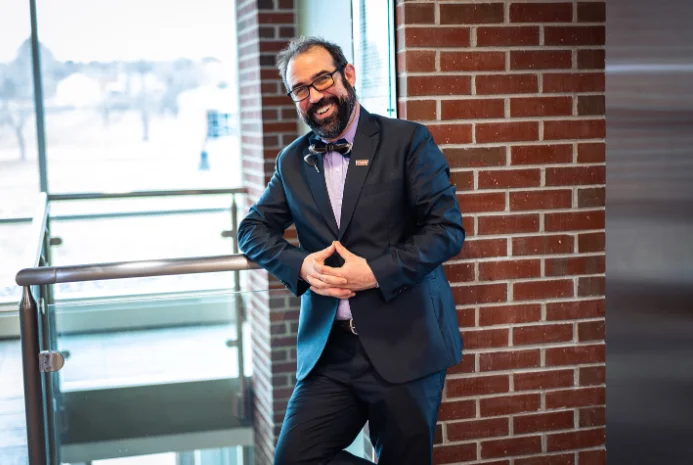
“A United States education is still valued around the world,” Shorty explained. “International students bring new perspectives to campus and help us address the shrinking number of local students.” For him, the project was never just about enrollment; it was about creating a richer, more global community. Thomas College alumnus Laban Moian ’25, described Shorty as “the kind of leader who always made sure students were comfortable and guided them efficiently.”
“That’s just who Luke is,” he added.
Before arriving at Thomas, Shorty spent 12 years in education leadership roles that gave him international experience. At Lee Academy in Penobscot County in Maine, he oversaw programs that welcomed students from abroad and even helped run campuses in Shanghai, China, and Dengue, South Korea. At the Maine School of Science and Mathematics, he worked with international students and learned the ins and outs of academic, cultural, and administrative challenges. These experiences prepared him to navigate the complexities of recruitment, partnership-building, and student support on a global scale.
Success, however, has not come without setbacks. One of the toughest lessons came during the 2024 recruiting cycle, when Thomas received dozens of deposits from students in one country.
Excited, the college anticipated a large incoming class, but most of those students never arrived.
“In some countries, a deposit doesn’t mean the same thing,” Shorty explained. “Many students deposit at several schools just to secure visa paperwork. We learned the hard way.” That year, Thomas adjusted its system to focus on confirmed visas rather than deposits, a change that has since led to one of the strongest international classes in school history. Still, the challenge of limited resources and competing institutional priorities remains.
Behind Shorty’s professional strategy lies a deeply human philosophy. “We are all human beings who share the same air, live on the same planet, and want the same things, peace and prosperity for our families and neighbors,” he said. He believes that genuine relationships, not just transactions, are the foundation of lasting connections across borders. “Politics and governments come and go, but relationships between people last.” His approach is one of abundance— abundance of care, friendship, dignity, and equity.
Looking to the future, Shorty hopes the legacy of his international recruitment project endures beyond Thomas itself. “I hope it’s not just about Thomas College but about Waterville and the state of Maine,” he said.
For Shorty, bringing international students to Thomas is not just about addressing enrollment numbers, it’s about transformation. It enriches rural Maine students by exposing them to global cultures, while giving international students a window into American life outside the big cities.
This article was originally written for Dr. Lisa Hibl’s EH 250/CO 250 Journalism class in Fall 2025.